

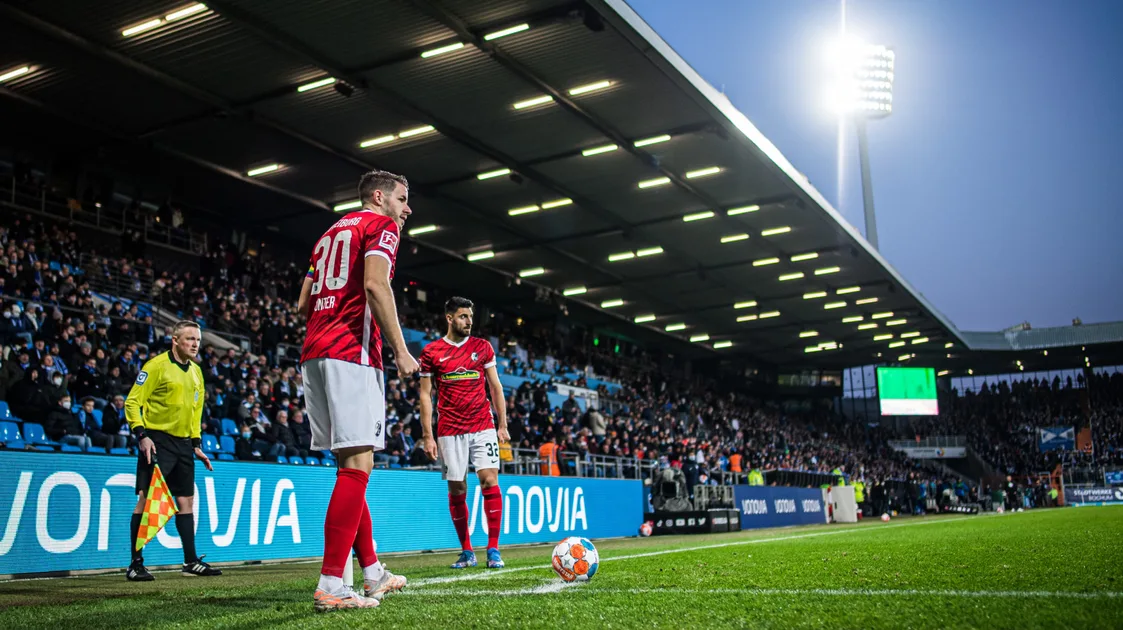
In the 2021/22 Bundesliga season, many teams pushed their fullbacks high up the pitch, turning wide defenders into primary sources of crosses, cut-backs and overloads that directly inflated shot totals and corner counts. This shift in structure did not just change tactical aesthetics; it altered how matches flowed statistically, shaping when pressure waves arrived, where shots were generated and how often deflections and blocks forced corners.
Why Aggressive Fullbacks Naturally Generate More Shots
When fullbacks advance early in build-up, they add one extra player to the attacking line and stretch the opposition’s horizontal shape, creating new passing lanes into the box. That additional wide threat forces wingers to drift inside, so central pockets open for shots around the “half-spaces” and top of the area. As a result, the team can circulate the ball faster across the final third, producing more shooting opportunities per possession than a structure where fullbacks stay deeper and only support cautiously.
The constant overlapping and underlapping runs also increase the chance of low crosses and cut-backs into high-probability zones between the penalty spot and the six-yard box. Defenders facing their own goal must choose between blocking the passing lane or tracking central runners, which means even half-cleared balls drop invitingly for second shots. Over a full Bundesliga campaign, that pattern translates into a higher volume of attempts for teams whose fullbacks are encouraged to attack repeatedly rather than prioritise conservative positioning.
How Fullbacks Turn Wide Pressure into Corners
Persistent wide pressure is one of the most reliable ways to drive up corner counts, and attacking fullbacks sit at the core of that dynamic. By receiving near the touchline and carrying the ball toward the byline before delivering, they force defenders into urgent recovery runs where small mis-timings lead to blocks behind the goal rather than controlled clearances into central areas. The closer the cross is released to the end line, the more likely a defensive touch sends the ball out for a corner instead of safely upfield.
Bundesliga corner statistics from recent seasons show that teams with strong attacking profiles often rank highly both in shots and corners, underlining the link between sustained pressure and set-piece volume. When fullbacks repeatedly recycle attacks by playing off nearby midfielders and wingers, they keep the ball in advanced wide zones for longer stretches, increasing the number of duels and blocks that can deflect out of play. In live betting terms, spotting matches where fullbacks are dominating territory on both flanks provides a concrete clue that late corners may continue to accumulate rather than taper off.
Structural Traits of 2021/22 Bundesliga Fullback Play
Across the 2021/22 Bundesliga, the teams that leaned hardest into attacking fullbacks shared recognisable structural traits. They favored back-four systems that morphed into back-three structures in possession, with one midfielder dropping into the defensive line so both fullbacks could advance simultaneously without leaving obvious counter-attack lanes. In several sides, wide defenders were among the league leaders in crosses and key passes from open play, underscoring how coaching choices deliberately turned them into creators rather than purely auxiliary supporters.
Many of these teams also instructed their fullbacks to arrive in advanced zones early in transitions rather than waiting for settled possession, which increased the volume of early crosses against partially organised defenses. That in turn produced more blocked attempts and hurried clearances, contributing both to shots from the edge of the box and to corners. Over time, this tactical commitment created a feedback loop: opponents adjusted by committing extra cover to wide areas, freeing central spaces for late runners and ensuring that the wide origin of attacks still paid off even when the first cross was stopped.
Mechanism: From Fullback Positioning to Set-Piece Volume
To see how fullback positioning influences set-piece volume, consider the chain that begins with their starting height on the pitch. When fullbacks begin a phase already beyond the halfway line, the distance to the byline shortens, so they can arrive in dangerous crossing zones before the defensive block is fully set, forcing defenders into emergency blocks. Those emergency actions are rarely precise; centre-backs prioritise contact over direction, which tends to send the ball behind the goal or out to the sides, yielding corners and throw-ins rather than clean clearances.
The mechanism becomes even more pronounced when the attacking side repeatedly switches play from one fullback to the other. Each long diagonal requires defenders to shuffle across, stretching the line and increasing the odds that a late-arriving fullback catches an opponent isolated, again ยูฟ่าเบท to rushed blocks. Over ninety minutes, these small interactions accumulate, and teams that enable their fullbacks to push high from the outset tend to create the kind of chaotic box sequences that produce multiple corners in clusters rather than in isolated incidents.
Reading Aggressive Fullbacks from a Live-Betting Perspective
From a live-betting angle, fullback behavior offers an early signal about how shot and corner markets may develop relative to pre-match expectations. Within the first fifteen minutes, a bettor can note how often fullbacks receive beyond the opposing winger, whether they are trusted to deliver or merely recycle possession backwards, and how many times their crosses are blocked versus allowed to travel unchallenged. A game where both fullbacks are already hitting multiple entries into the box is more likely to produce sustained pressure and late corners than one in which they remain pinned near the halfway line.
In addition, observing the opposition’s response matters: if the defending side instructs its wide players to track fullbacks all the way to the defensive line, central channels open for cut-backs that increase high-quality shots, which in turn can encourage further attacks if the score remains level. Conversely, when fullbacks are ignored and given space to cross without pressure, the likelihood of cleared balls and resulting corners decreases slightly because defenders can meet the ball with better body shape. The most promising in-play situations for overs on corners usually feature high fullbacks and actively pressured crosses where defenders consistently block under time pressure.
Tactical Patterns That Amplify Fullback Impact on Corners
Some tactical patterns in the 2021/22 Bundesliga amplified how fullbacks translated territory into corners. Teams that overloaded one flank, for instance, often positioned both the fullback and winger wide while a central midfielder drifted over to create three-on-two scenarios, forcing defenders deep and narrow. Those overloads made it difficult for the back line to step out cleanly, so many clearances occurred inside the box with limited control, raising the probability that touches diverted the ball behind the goal.
Another effective pattern involved using fullbacks as underlapping runners into the half-space, drawing attention away from wingers waiting to cross from slightly higher positions. When defenders tracked the underlap, wingers found enough time to whip in deliveries that defenders could only block at close range. Over a season, sides that consistently executed these patterns not only scored from open play but also accumulated high corner figures, confirming that sophisticated wide mechanisms are directly reflected in set-piece statistics.
To make these links practical for in-play decisions, it helps to outline the main tactical patterns and their typical statistical consequences.
- Overlapping fullback plus inverted winger on one flank tends to increase early crosses and blocked deliveries, raising corners.
- Underlapping fullback into the half-space encourages low cut-backs, which increase high-xG shots but may slightly reduce corner likelihood if defenders intercept earlier.
- Switching play aggressively between fullbacks stretches the back line, causing more last-ditch blocks close to the byline and sustained corner pressure.
- Using a fullback to pin the opposing winger deep can create space for central runs, boosting shot volume more than corner counts when cut-backs reach free runners.
Interpreting these patterns in real time helps a bettor separate matches where fullbacks merely advance from those where they actively drive repeat events in the box. Overlapping patterns with heavy crossing produce a steady stream of deflections and forced saves that often generate both corners and rebound shots. Underlapping approaches, by contrast, may emphasize cleaner chances from inside channels, so they can be better suited to live decisions on goals rather than corner totals when the wide play is sharp but not constantly blocked at close range.
Statistical Indicators: Fullbacks, Crosses and Corners
Beyond visual observation, certain statistical indicators from Bundesliga data provide clues about the contribution of fullbacks to attacking events. Teams whose wide defenders rank near the top for crosses from open play and key passes typically show above-average totals for corners and total shots, reflecting sustained wide pressure. Moreover, research on technical performance highlights that high-ranked attacking sides often excel in metrics connected to offensive organization—shots, key passes and crosses—while corner volume tracks with overall attacking dominance.
A simple comparative table can clarify how these indicators relate to one another conceptually, even without listing specific clubs or players.
| Indicator Type | Fullback Link | Probable Impact on Shots | Probable Impact on Corners |
| Crosses from open play per 90 | Direct measure of wide delivery involvement | More attempts after second balls | More blocks and clearances behind |
| Touches in final third | Frequency of advanced fullback positioning | Increased shooting opportunities | Higher chance of deflections out |
| Key passes from wide zones | Quality of chance creation from flanks | Better shot quality, not just volume | Corners if passes are blocked or miscleared |
| Team corners per match | Outcome of sustained territorial pressure | Correlates with overall attack | Direct signal of wide pressure payoff |
| Shots from wide channels | Volume of flank-originated attempts | Higher total attempts, lower xG each | More rebounds and blocked efforts |
The relationships in the table show why combining event-level stats with positional understanding of fullbacks is crucial. High corners per game plus heavy fullback crossing suggests a game state where wide defenders are central to the attacking plan, making late-corner overs more plausible if the attacking side continues to chase a result. On the other hand, low corner totals alongside modest crossing figures from fullbacks point toward either deliberate central attacks or conservative wide play, scenarios in which expecting a sudden spike in corners near full time would be less grounded in what the numbers imply.
Incorporating Fullback Behavior into Data-Driven In-Play Models
For a data-driven bettor, fullback activity becomes one input among many in an in-play model that updates probabilities during the match. Live data feeds often track passes received, final-third touches and crosses, which can be filtered by position to approximate how aggressively fullbacks are operating on a given day. When those figures exceed pre-match expectations, the model can adjust upwards the projected totals for shots and corners, especially if the scoreline keeps the attacking side motivated to push.
In parallel, visual assessment remains necessary to interpret whether those numbers stem from structured dominance or from chaotic, end-to-end play with little control. Fullbacks who bomb forward without protection might generate some early corners but also invite counter-attacks that force their team to retreat, flattening the attacking volume over the rest of the half. Integrated models therefore need to weigh game state, fatigue and substitutions, recognising that an early injury to a key fullback or a tactical shift to a back five can quickly invalidate assumptions about sustained wide pressure.
When in-play models suggest that aggressive fullback activity is likely to persist, some bettors turn attention to where they can operationalise those edges in real time. For users engaging through a betting destination that offers granular live markets on corners and shots, the disciplined approach is to treat the interface as a tool for executing model-based edges: separating positions opened on corner totals from those on match outcomes, sizing stakes according to bankroll rules rather than emotional reactions to a few attacking waves, and logging how fullback-related signals—crosses, overlaps, heatmaps—correlate with long-term profitability in that specific environment, rather than assuming that every high-intensity wide performance guarantees an immediate pay-off.
Evaluating Market Mispricing Around Fullback-Driven Corners
Market mispricing often emerges when bookmakers and bettors focus more on team reputations than on how current tactical setups channel attacks. A traditionally central-focused Bundesliga side that suddenly empowers its fullbacks may produce a temporary disconnect between how its matches are priced and how they actually unfold, especially in early-season fixtures. Corner lines might remain anchored to historical averages even while wide patterns already indicate a shift toward higher crossing volume and more blocked deliveries.
To evaluate whether mispricing exists, bettors can compare pre-match expectations for corners and shots against early in-game indicators. If fullbacks immediately show high touch counts in advanced zones and repeatedly attack the byline while the line on corners has not yet adjusted, the probability that the total surpasses its pre-match mark meaningfully increases. Conversely, where fullbacks appear reserved despite pre-match narratives of attacking football—perhaps due to a tactical tweak or opponent-specific plan—corner overs become less appealing, reminding bettors that fullback behavior should be treated as an evidence-based check against generic assumptions.
In matches where corner volume, shot counts and fullback involvement collectively point toward a statistically energetic contest, some observers still need a structured way to decide if and when to intervene during play. For those who access live football markets through a casino online website, the core challenge lies in separating structured, data-based decisions from impulsive reactions to a dramatic attack: using pre-defined triggers such as a minimum number of fullback-originated crosses by a certain minute, tracking how that correlates with late-corner overs, and carefully ring-fencing the bankroll set aside for sports from any other activities on the same site so the logical edge derived from reading fullback patterns is not diluted by unrelated, less analytical wagering behavior.
Summary
Attacking fullbacks in the 2021/22 Bundesliga altered the statistical landscape of matches by increasing both shot volume and corner counts through constant overlapping runs, early positioning and repeated wide deliveries. Their advanced roles stretched defensive blocks, created more opportunities for cut-backs and forced defenders into rushed blocks that frequently diverted the ball behind the goal. For live bettors, recognising these patterns in real time—through both observation and data—offered a concrete way to gauge whether pre-match lines on corners and shots were likely to be exceeded.
However, the impact of fullbacks depended on tactical context, opponent responses and coaching adjustments, so blindly assuming that high fullback involvement always meant higher totals risked ignoring crucial nuances. By integrating positional behavior, event-level statistics and evolving game states, data-driven bettors could treat attacking fullbacks as a powerful but conditional indicator, using their actions to refine in-play expectations rather than as a standalone shortcut to profitable decisions.