

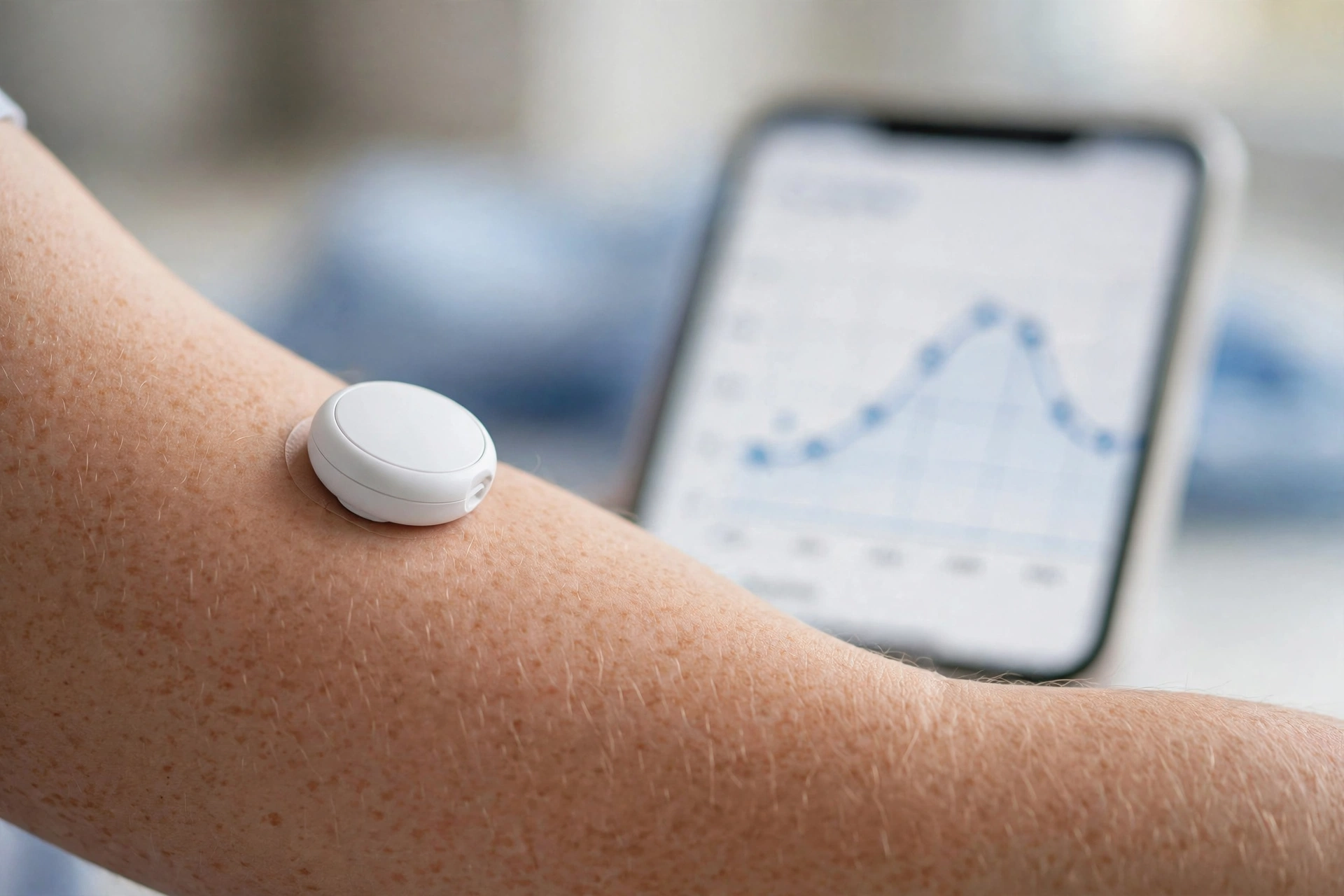
Continuous glucose monitors have transformed care for people who use insulin — and new evidence suggests their benefits reach much further. The largest clinical trial of its kind, published in the New England Journal of Medicine, has found that adults with type 2 diabetes who do not use insulin spent approximately five more hours a day in their target blood sugar range when they used a continuous glucose monitor.
What the Trial Found
Researchers reported that participants wearing a continuous glucose monitor — a small sensor, usually worn on the arm, that sends glucose readings to a phone or receiver throughout the day and night — achieved steadier blood sugar without adding insulin to their treatment. According to the University of Colorado Anschutz summary of the study, the improvement amounted to roughly five additional hours a day spent in the healthy target range, a difference clinicians consider meaningful for long-term health.
Time in range has become a central measure in diabetes care because it captures the daily reality that a single average reading can hide. Two patients can share the same average blood sugar while one swings between dangerous highs and lows and the other stays steady. More hours in range generally means fewer extremes — and it is the extremes, repeated over years, that are linked to damage to eyes, kidneys, nerves and blood vessels.
Why Feedback Changes Behaviour
The likely explanation is not the sensor itself but the feedback it creates. Finger-prick tests give a patient a few isolated numbers a day, often at the same predictable moments. A continuous monitor shows what happens after a particular meal, a missed walk, a poor night’s sleep or a stressful morning — in near real time. Patients in trials consistently describe the same discovery process: foods they assumed were harmless spike their glucose, while small changes, such as a short walk after eating, visibly flatten the curve.
That immediacy turns abstract advice into personal evidence. Instead of being told to eat differently in general, a person can see exactly which breakfast keeps them in range and which one does not. Clinicians can also review weeks of patterns with a patient rather than reconstructing months from memory and a handful of test strips.
Who Could Benefit Most
Type 2 diabetes affects hundreds of millions of people worldwide, and the large majority do not use insulin. Until now, monitors have usually been reserved for insulin users, partly because of cost and partly because evidence in other patients was thin. This trial strengthens the case for wider access, particularly for people whose blood sugar remains above target on oral medication, people with frequent low readings, and people newly diagnosed who are still learning how food and activity affect them.
The American Diabetes Association’s guidance on diabetes technology explains how monitors work and who they are currently recommended for; recommendations have been expanding as the evidence base grows, and large trials like this one are exactly what guideline committees and insurers look for when deciding whether to fund wider use.
Limits, Costs and Privacy Questions
The results come with practical caveats. Sensors must be replaced regularly, supplies add up, and coverage varies widely between health systems and insurers — a proven benefit does not automatically mean an affordable one. Some users also find constant data stressful rather than empowering, and readings still need sensible interpretation: a monitor is a tool for patterns, not a score to chase minute by minute.
There is a data question too. Monitors stream intimate health information to apps and cloud services, so choosing strong passwords and understanding app permissions matters. Our guide to keeping personal information private covers the basics that apply to health data as much as to banking. Technology is also reshaping care in other ways, as our report on how AI answers are rewriting search shows for information access more broadly.
The Bottom Line
Five extra hours a day in a healthy blood sugar range, achieved without insulin, is a substantial result — and it comes from information, not a new drug. If costs fall and coverage follows the evidence, continuous glucose monitors could become a standard tool for the much larger group of people with type 2 diabetes who manage their condition with lifestyle and oral medication alone. For now, patients curious about the technology have strong new evidence to discuss with their doctor at their next review.
