

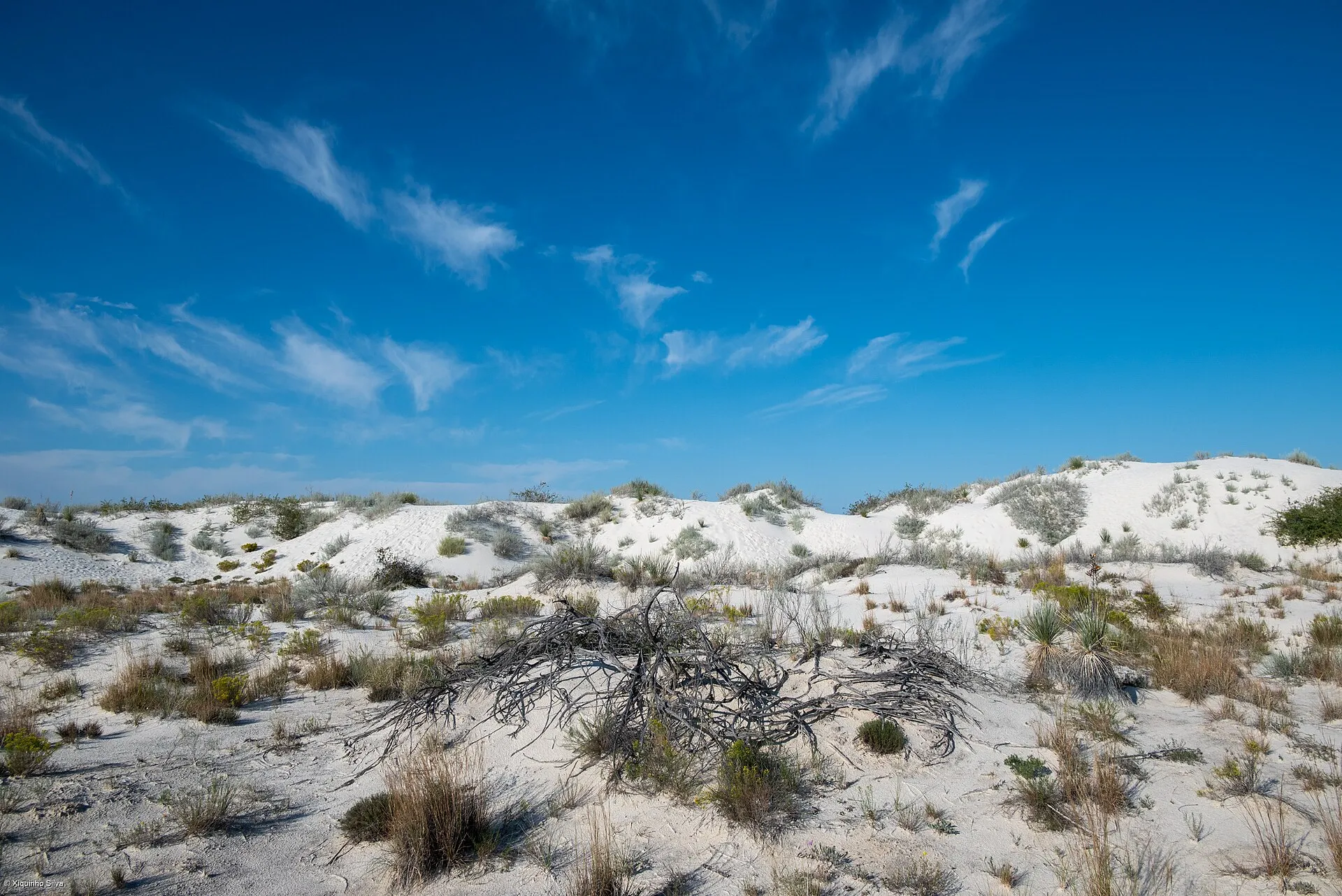
The economic history of a place usually starts with its resources, and few resources matter more than water. New research from White Sands in New Mexico applies that logic to the deep past, showing that some of the earliest known Americans lived beside a lake whose level swung with an unstable Ice Age climate, and managed their lives around that volatility.
Published in Science Advances (DOI 10.1126/sciadv.aeh0707), the study reconstructs conditions in the Tularosa Basin during the Last Glacial Maximum. Sediment evidence from ancient Lake Otero indicates repeated environmental change, including shifts in water availability and surrounding vegetation, across the period when humans were present in the basin.
The Evidence, in Brief
White Sands is globally known for fossil footprints dated in previous research to about 21,000 to 23,000 years ago, among the earliest direct evidence of people in North America. The new paper adds the environmental ledger to those footprints: the lake beside which people walked was expanding and contracting, and the ecosystem around it was changing with the climate.
For small communities, those fluctuations were the equivalent of repeated supply shocks. Water points moved, grazing animals redistributed themselves, and plant resources shifted. Sustained use of the basin under those conditions implies planning, memory and flexibility, the same capacities any society needs when its resource base becomes unreliable.
Reading the Study Carefully
The authors base their reconstruction on multiple sediment proxies rather than a single measure, which strengthens the conclusions while leaving normal scientific uncertainty about exact timing. The full text is available via Science Advances.
We take a similar evidence-first approach in our finance and policy coverage, and in reports such as our article on the US Measles Update: 4,410 Cases and How Vaccination Prevents Spread.
The Takeaway
Volatility as a Resource Test
Economists who study resource-dependent communities will recognise the White Sands pattern. Volatility, not average conditions, is what stresses a society: a lake that is generous on average but unreliable year to year demands storage, diversification and social networks that can move food and information between places. The basin’s inhabitants appear to have practised all three in prehistoric form.
That reading also explains why the site’s occupation persisted. A community organised around a single fixed resource would have been forced out by the first major shoreline shift. One organised around knowledge, mobility and exchange could treat each shift as a problem to be routed around, which is what the long archaeological record suggests happened.
Policymakers reading research coverage sometimes ask what an Ice Age lake has to do with them. The honest answer is that the study’s value is diagnostic rather than prescriptive: it demonstrates, with unusual clarity, which social capacities matter when a resource base turns volatile. Societies that diversify, store knowledge and cooperate across distance cope; the archaeological record at White Sands shows those capacities operating successfully more than twenty thousand years before they had names.
The study will be cited in arguments about early settlement for years, but its most durable contribution may be methodological. By tying a famous archaeological site to a quantified climate record, it gives other researchers a template for doing the same at their own sites. Evidence of that quality travels well, and the standard it sets is likely to raise expectations across the field.
Strip away the archaeology and the finding is simple: during the coldest, most unstable chapter of the last ice age, people in what is now New Mexico faced abrupt changes in the resource they depended on most, and adapted. It is among the earliest documented examples of a challenge that societies, and economies, have been managing ever since.
