

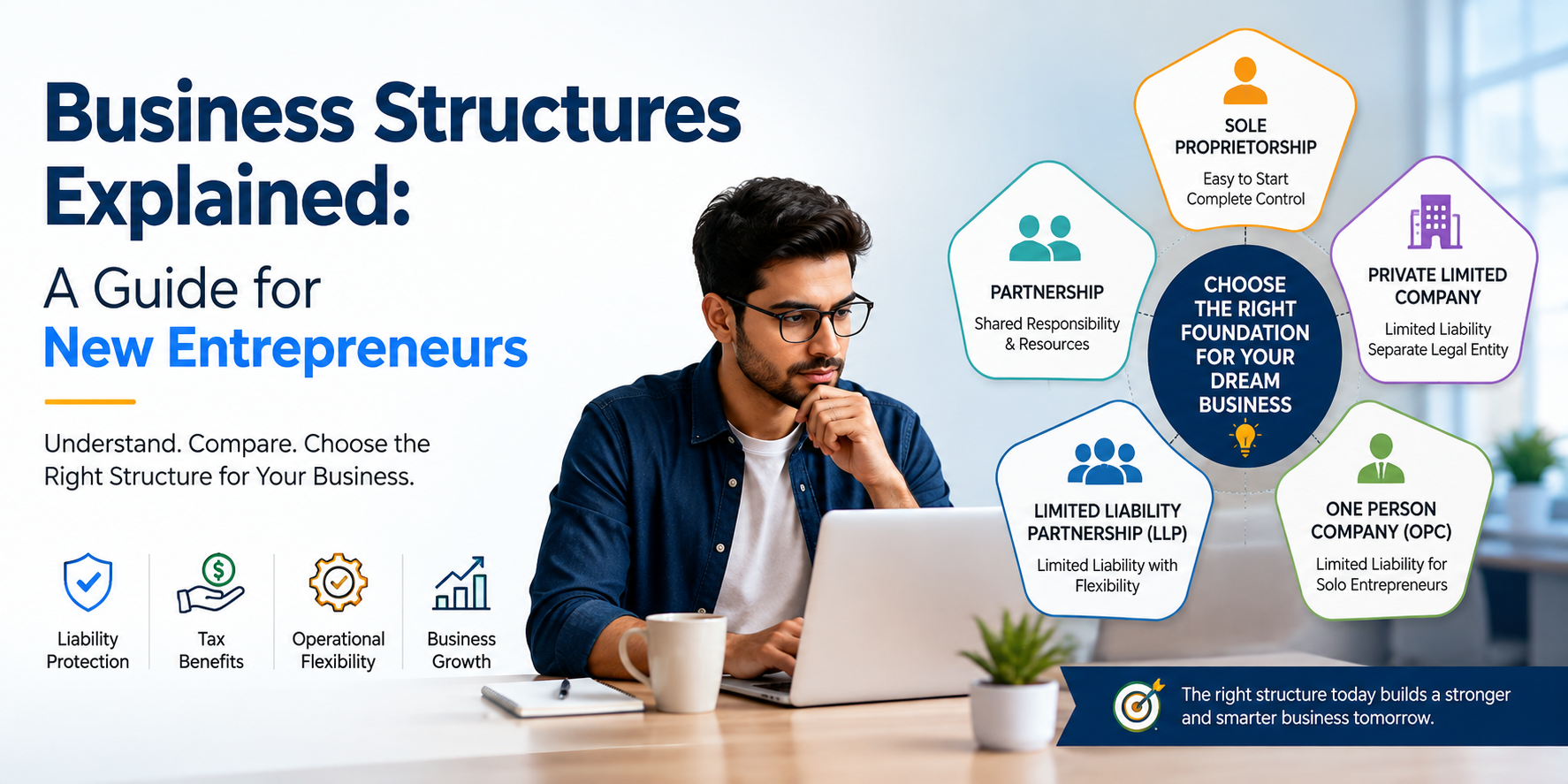
Introduction
Ask a new entrepreneur why they registered a Private Limited Company registration instead of an LLP, and you’ll often hear that’s what everyone does rather than an actual reason. That’s not a criticism, legal terms like separate legal entity, limited liability, and perpetual succession sound abstract until you understand what they actually mean for your business. And once you do understand them, the choice between structures stops being a guess and starts being a decision.
This matters because every business structure in India carries a genuinely different legal personality. A Sole Proprietorship is legally the same person as its owner. A Private Limited Company is legally a completely separate person from its shareholders, it can own property, sue, and be sued in its own name, and it doesn’t cease to exist just because a shareholder does. Understanding these underlying concepts, not just the compliance checklist, is what helps a new entrepreneur read a legal document, a funding term sheet, or a compliance notice and actually understand what it means for their business.
The Core Concepts Every Entrepreneur Should Understand First
Before comparing structures, it helps to understand four ideas that show up in every discussion of business entities:
What is a separate legal entity?
A separate legal entity is a business structure that is legally distinct from its owners, meaning it can own assets, enter contracts, sue, and be sued in its own name, independent of the people who run it.
What is limited liability?
Limited liability means an owner’s personal assets are protected from business debts, their financial risk is limited to what they’ve invested or agreed to contribute.
What is perpetual succession?
Perpetual succession means a business entity continues to exist even if an owner, partner, or director changes, resigns, or passes away, the entity itself doesn’t dissolve.
What is transferability of ownership?
Transferability refers to how easily ownership can be sold, gifted, or transferred to someone else; shares in a company are generally easier to transfer than a partner’s stake in a firm.
Keep these four concepts in mind as we walk through each structure, they’re what actually separates one from another, far more than the paperwork does.
Sole Proprietorship: You Are the Business
A Sole Proprietorship is a business owned and run by a single individual, with no legal separation between the owner and the business, recognised through operational registrations like GST, Udyam, or a Shop & Establishment licence rather than a dedicated incorporation statute.
Real-world context: This is the structure most freelancers, consultants, tuition centres, and neighbourhood shops use, it’s fast, cheap, and requires minimal paperwork, which is exactly why it remains the most common structure among India’s smallest businesses.
In practice:
- No perpetual succession, the business effectively ends if the owner stops operating it
- No transferability, you can sell business assets, but not the entity itself
- Full personal liability, but also full personal control
Partnership Firm: Shared Ownership, Shared Risk
A Partnership Firm is formed when two or more individuals agree to carry on a business together and share its profits, governed by the Indian Partnership Act, 1932 and typically formalised through a Partnership Deed.
Here’s the concept that trips up most new entrepreneurs: partners in a firm have unlimited, joint, and several liability. That means each partner isn’t just liable for their own share of a debt, they can be held responsible for the entire debt, including obligations another partner created, if that partner can’t pay.
Real-world context: Several well-known Indian conglomerates, including some divisions historically linked to Hindustan Petroleum and Mahindra & Mahindra group entities, trace early structures to partnership arrangements under the 1932 Act, though most large businesses have since moved to company structures as they scaled and sought outside capital.
In practice:
- No separate legal entity in the traditional sense, the firm and partners are closely intertwined
- No perpetual succession by default, a partner’s exit or death can dissolve the firm unless the deed provides otherwise
- Works well when partners have high mutual trust and don’t need outside equity investment
Limited Liability Partnership (LLP): Partnership Flexibility, Company-Style Protection
A Limited Liability Partnership is a separate legal entity under the LLP Act, 2008, that combines the operational flexibility of a partnership with limited liability protection for its partners, meaning a partner’s personal liability is capped at their agreed contribution to the LLP.
This is the structure that resolves the biggest weakness of a traditional partnership. Because an LLP is a separate legal entity formed through LLP Registration, it can own property and enter contracts in its own name, and it has perpetual succession; a partner leaving or passing away doesn’t automatically dissolve the LLP.
Real-world context: LLPs are the structure of choice for CA firms, law firms, architecture practices, and consulting businesses, professions where partners want limited liability and lighter compliance, but don’t need to raise equity capital from outside investors.
In practice:
- Requires a minimum of 2 designated partners; no upper limit
- Governed by an LLP Agreement, not a Memorandum and Articles of Association
- Cannot issue shares, so it isn’t suited to businesses planning venture capital funding
One Person Company (OPC): A Separate Legal Identity for a Solo Founder
A One Person Company is a company with a single shareholder, registered under Section 2(62) of the Companies Act, 2013, that gives a solo entrepreneur the benefits of a separate legal entity and limited liability without requiring a second founder.
An OPC solves a specific problem: previously, Indian company law required a minimum of two shareholders to form a company, which meant solo founders were stuck with a Sole Proprietorship and its unlimited liability, or had to find a nominal second shareholder. The OPC structure removed that requirement, a single person can now hold a separate legal identity for their business.
Real-world context: Since the Companies (Incorporation) Second Amendment Rules, 2021, even NRIs can incorporate an OPC, and the residency requirement for resident Indian citizens was reduced from 182 to 120 days, opening this structure to a much wider set of solo entrepreneurs than when it was first introduced.
In practice:
- Must appoint a nominee (via Form INC-3) who steps in if the sole member dies or becomes incapacitated
- Cannot be converted into a Section 8 (non-profit) company
- Since 2021, there is no mandatory conversion trigger based on turnover or paid-up capital, an OPC can grow without forced restructuring
Private Limited Company: The Structure Built for Growth and Outside Capital
A Private Limited Company is a business entity privately held by shareholders, registered under Section 2(68) of the Companies Act, 2013, offering limited liability, a separate legal identity, perpetual succession, and, critically, the ability to issue shares to outside investors.
This is the structure that makes fundraising practical. Because ownership is represented by shares, a Private Limited Company can bring in new investors by issuing new shares, without dissolving or restructuring the underlying entity. It can also issue Employee Stock Options (ESOPs), something a Sole Proprietorship, Partnership, or LLP cannot do.
Real-world context: Most VC-funded Indian startups, from early-stage seed rounds through to pre-IPO growth stages, are structured as Private Limited Companies precisely because investors expect equity shares, board representation, and standard shareholder protections that only a company structure provides.
In practice:
- Requires a minimum of 2 shareholders and 2 directors (maximum 200 shareholders)
- Governed by a Board of Directors, with mandatory annual audits regardless of turnover
- Shares are not freely tradable to the public (unlike a Public Limited Company), but can be transferred among approved parties per the Articles of Association
How the Structures Behave Differently: A Concept-Based Comparison
| Concept | Sole Proprietorship | Partnership Firm | LLP | OPC | Private Limited Company |
| Separate legal entity? | No | No | Yes | Yes | Yes |
| Owner liability | Unlimited | Unlimited, joint and several | Limited to contribution | Limited to shares | Limited to shares |
| Perpetual succession? | No | Not by default | Yes | Yes | Yes |
| Can raise equity funding? | No | No | No | Not practical | Yes |
| Can ESOPs? | No | No | No | No | Yes |
| Governing law | No dedicated statute | Indian Partnership Act, 1932 | LLP Act, 2008 | Companies Act, 2013 | Companies Act, 2013 |
Did You Know? The concept of perpetual succession is why a company’s Certificate of Incorporation doesn’t need to be reissued when a director resigns or a shareholder sells their shares, the entity itself never legally pauses, even though the people behind it changed.
Quote: A business structure isn’t just a form you file, it’s the legal personality your business will carry for as long as it exists.
Latest News: With India’s startup ecosystem now home to over 1.59 lakh DPIIT-recognised startups, the overwhelming preference for the Private Limited Company structure among funded startups reflects how central the separate legal entity and shares combination has become to the modern Indian fundraising process.
Case Study: Two former colleagues started a design consultancy as a Partnership Firm, trusting their long friendship to manage the business informally. When a client dispute led to a legal claim against the firm, both partners’ personal assets were exposed, including one partner’s home, held jointly with a spouse.
Had they understood that a Partnership Firm offers no separation between personal and business liability, they may have chosen an LLP instead, which would have capped their exposure to their agreed contribution.
Which Structure Fits a New Entrepreneur?
- You’re testing an idea solo, with minimal risk: Sole Proprietorship
- You’re testing an idea solo, but want liability protection: OPC
- You’re partnering with someone you trust deeply, low risk, no funding plans: Partnership Firm
- You’re partnering with someone but want liability protection and lighter compliance than a company: LLP
- You’re building something you plan to fund with outside investors: Private Limited Company
Conclusion
Understanding business structures isn’t about memorising a compliance checklist, it’s about understanding what kind of legal personality your business will have, who’s exposed if something goes wrong, and whether the structure can actually support your growth plans. A Sole Proprietorship and Partnership Firm keep things simple but leave you personally exposed. An LLP offers a genuine separate legal entity with capped liability, ideal for professional and service businesses.
An OPC gives a solo founder that same protection without a co-founder. And a Private Limited Company remains the structure built specifically for businesses planning to raise outside capital. Once you understand why each structure works the way it does, choosing the right one, and explaining that choice to an investor, a bank, or a new partner, becomes far easier.
Why Choose Zolvit
- Expert lawyers, Chartered Accountants, and Company Secretaries who explain your options in plain language, not just legal jargon
- Personalised guidance matched to your risk profile, funding plans, and growth stage
- End-to-end registration across Sole Proprietorship, Partnership, LLP, OPC, and Private Limited Company
- Transparent, affordable pricing with no hidden charges
- Ongoing compliance support so your chosen structure stays in good standing
- Dedicated support from your first consultation through incorporation and beyond
FAQs
1. Can a Sole Proprietorship enter into contracts in its own name?
NO. A Sole Proprietorship has no separate legal identity from its owner, so contracts are legally entered into by the owner personally, not by the business as a distinct party.
2. Does a Partnership Firm end automatically if one partner leaves?
YES, by default. Under the Indian Partnership Act, 1932, a firm can dissolve when a partner exits unless the Partnership Deed specifically provides for the firm to continue with the remaining partners.
3. Is an LLP considered a separate legal entity like a company?
YES. An LLP is a separate legal entity under the LLP Act, 2008, meaning it can own property, enter contracts, and sue or be sued in its own name, independent of its partners.
4. Can an OPC have more than one shareholder?
NO. An OPC is defined by having exactly one member, along with a mandatory nominee. If a business needs more than one owner, a Partnership Firm, LLP, or Private Limited Company is the appropriate choice instead.
5. Why do investors prefer Private Limited Companies over LLPs?
Because a Private Limited Company can issue equity shares and ESOPs, giving investors standard shareholding rights, board representation, and exit mechanisms that an LLP’s contribution-based structure cannot offer.
6. Does limited liability mean an owner has no risk at all?
NO. Limited liability caps an owner’s financial exposure to their investment or agreed contribution, it protects personal assets beyond that, but the invested capital itself can still be lost if the business fails.
7. Can a business change its structure after it’s been explained and chosen incorrectly?
YES. Most structures can be converted into another, for instance, a Partnership Firm into an LLP, or an LLP into a Private Limited Company, though conversion involves fresh filings and is best avoided by understanding the structures properly at the outset.
